
Clinton County Court Records After Arrest
A jail arrest in Clinton County starts with law enforcement, but the court record begins when the Clinton County Prosecuting Attorney reviews the facts and files a complaint, information, or other charging paper. The Missouri Association of Prosecuting Attorneys lists Brandi McClain as the Clinton County Prosecuting Attorney, with a Plattsburg mailing address and phone line. That office decides whether booking allegations become formal court charges. Once charges are filed, the record belongs to the Clinton County Circuit Court and the statewide Missouri court system.
The custody side and the court side should not be treated as the same record. The Clinton County jail inmate records page is the place to check current jail custody, while the Clinton County jail mugshots page covers booking photos and photo requests. Court records after an arrest show case numbers, filed charges, hearing events, bond orders, warrants, dispositions, and other docket activity. A charge is an accusation. It is not a conviction unless the case ends with a guilty plea, guilty verdict, or other qualifying judgment.
The official Clinton County court page is useful because it lists the local judges, circuit clerk email, court phones, courthouse rules, and mailing address. It also points users toward Missouri's court system for online searches. For people going to court after an arrest, the same page gives practical courthouse rules: no shorts when appearing in court, cell phones should be left in the vehicle, and metal detectors are used at the courthouse entrance.
The research image below comes from the Clinton County Circuit Court contact page, which is the local court source for criminal court phone routing and courthouse-entry rules.
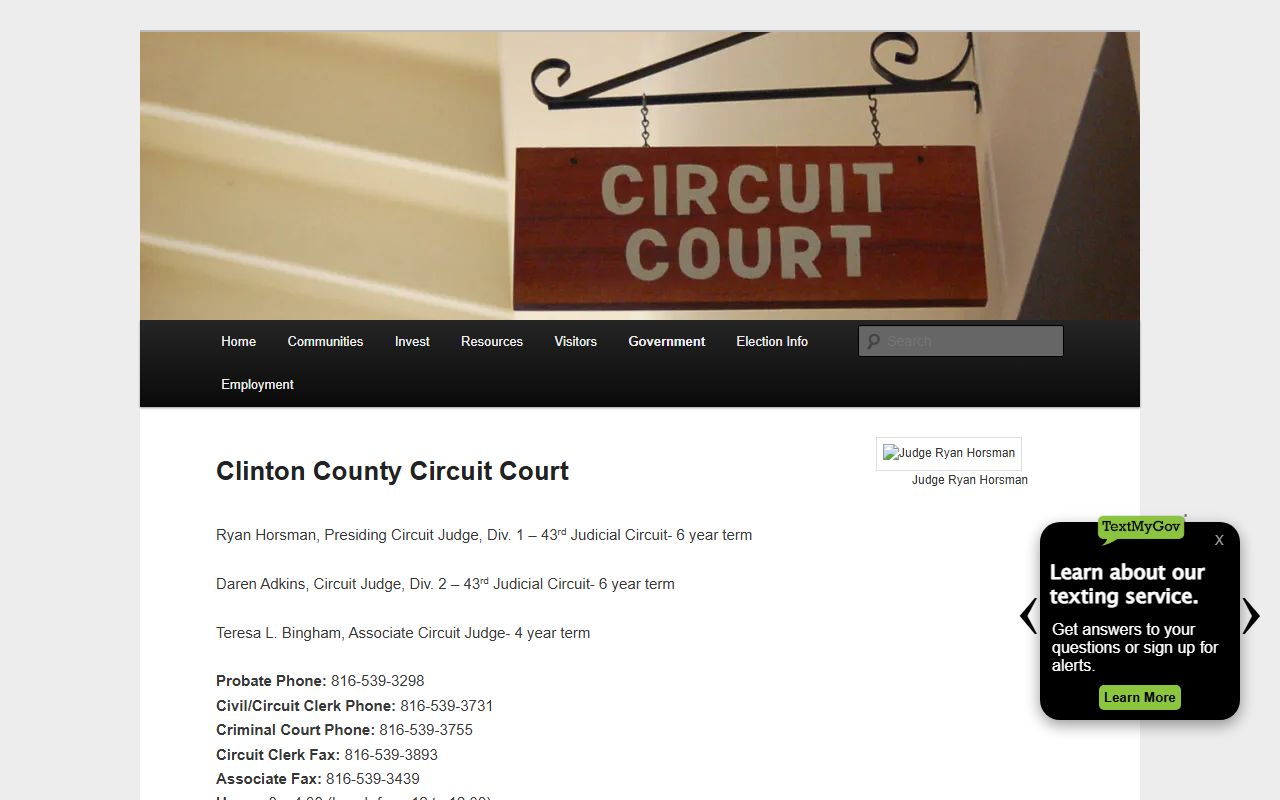
The court contact page matters because a jail booking alone does not tell a reader whether a prosecutor has filed, changed, or dismissed formal court charges.
Find Clinton County Arrest Court Records
Missouri's public case-search path is Missouri Case.net. During research, direct screenshot access to Case.net returned an access block, but Clinton County court materials and Missouri court practice still identify it as the public search destination for case records. Use the person's legal name if a case number is not known. If jail paperwork, bond papers, or a summons lists a case number, search by that number first because name spellings and aliases can hide a case.
- Open Missouri Case.net and choose a litigant-name or case-number search.
- Search the defendant's name, then narrow by Clinton County or the 43rd Judicial Circuit when filters are available.
- Open the matching case and read the charge list, docket entries, bond orders, and next court date.
- Call the Clinton County criminal court phone line if the case is missing, sealed, too new to appear, or unclear.
Case.net is not a jail roster. A person can be booked before a case appears, and court charges can differ from the arresting officer's booking language. For time-sensitive custody, call the jail. For time-sensitive court settings, use the Clinton County criminal court number listed by the county court page.
| Search Method | Use It When | Clinton County Note |
|---|---|---|
| Litigant name | No case number is known | Try full legal name and common aliases. |
| Case number | Paperwork lists a docket number | Best match for bond papers and summons forms. |
| Filing date or county filter | Several people share a name | Use Clinton County or 43rd Judicial Circuit filters if shown. |
Charges Filed After Clinton County Arrest
After a Clinton County arrest, the booking entry may list a suspected offense, warrant, hold, or arrest basis. The prosecutor then decides what charge to file in court. A complaint can start a case from sworn facts. An information is a prosecutor-filed charge, often used in felony practice. An indictment is a grand-jury charge. Each document can create a court record after an arrest, but the path and timing may differ.
| Document | Filed By | What It Does |
|---|---|---|
| Complaint | Prosecutor or sworn charging source | Starts a criminal case from alleged facts. |
| Information | Prosecutor | States formal charges selected by the prosecutor. |
| Indictment | Grand jury | Charges returned through a grand-jury process. |
The Missouri Association of Prosecuting Attorneys directory lists the Clinton County Prosecuting Attorney contact. Prosecutor contact does not replace the court docket, but it helps identify the office that reviews police reports and chooses whether the arrest leads to a filed case.
Clinton County Charge Status
Charge status changes as the court case moves. A pending charge is still open. An amended charge has been changed, often by statute, count, degree, or level. A reduced charge is less severe than the charge first filed. A dismissal means the charge is no longer being pursued in that case, though the exact effect depends on the order and any refiling rights. A disposition is the court outcome, such as guilty plea, trial verdict, dismissal, or other final action.
| Status | Plain Meaning | Why It Matters |
|---|---|---|
| Pending | The charge is still active. | Court dates, bond conditions, and warrants may still apply. |
| Amended | The filed charge changed. | The jail booking wording may no longer match the court case. |
| Dismissed | The court ended that charge in the case. | Public records may still show the arrest unless later closed by law. |
| Convicted | A guilty plea or verdict was entered. | Sentencing, probation, jail, or prison transfer may follow. |
Missouri's warrantless-detention statute is also important early in the case. It limits detention after a warrantless arrest without charging and preserves reasonable access to counsel or others acting for the person held.
Bond After a Clinton County Arrest
Bond information should be confirmed through both custody and court channels. The Clinton County research did not locate a sheriff-published online bond payment schedule or fee page. The practical chain is to check the inmate portal, call the jail, and verify the formal court order through Case.net or the Clinton County criminal court phone line. A bond amount on jail paperwork may not release a person if a no-bond order, parole hold, warrant from another county, federal detainer, or immigration hold is also active.
| Bond or Hold | How It Works |
|---|---|
| Cash bond | Money is posted directly and handled under court rules. |
| Surety bond | A licensed bond agent guarantees the bond for a fee. |
| Recognizance release | The person signs a promise to return and follow conditions. |
| No-bond hold | Payment will not release the person until a judge changes the order. |
| Detainer | Another agency asks the jail to hold the person after local release. |
Warrants and Arrest Records
No official Clinton County sheriff warrant-search page was located in the research. The sheriff site has a crime-tip form, but that form is not a warrant lookup and is not a public-records request form. Warrant checks should route through the sheriff's non-emergency line, the sheriff office phone, Missouri Case.net, or the Clinton County criminal court phone line. If the issue is a closed or hard-to-find record, use a Missouri Sunshine Law request to the public body that keeps the record.
Missouri Section 221.515 is relevant when a warrant meets jail custody. It authorizes designated jailers to serve arrest warrants on people who surrender to, or are already inmates in, the jail. A Clinton County booking can therefore start with a new arrest, a surrender on a warrant, or service of a warrant on a person already held.
Charges, Convictions, Sealed Records
Public court records after a jail arrest must be read by stage. A charge is an accusation selected by the prosecutor. A conviction is a court outcome after a plea or verdict. A sealed record is hidden from ordinary public access under a court order or statute. Expungement or closure under Missouri law can limit public access to eligible arrest records, but it does not mean every copy on every system disappears at once.
| Term | Meaning | Record Effect |
|---|---|---|
| Charge | Formal accusation | Can be pending, amended, dismissed, or resolved. |
| Conviction | Guilty plea or finding | Can affect sentencing, probation, or prison transfer. |
| Sealed record | Public access is restricted | Some agencies may still have limited access. |
| Expunged or closed arrest | Access is limited by law and order | Eligibility depends on Missouri statutes and the case result. |
Missouri access law: RSMo 610.100 makes arrest and incident reports open records subject to statutory closures, while RSMo 610.122 addresses closure of eligible arrest records.
Restricted Clinton County Court Records
Some records tied to an arrest may be closed or redacted. Missouri Section 610.021 lists categories that may be closed, including certain law-enforcement, security, medical, juvenile, and protected records. Court-specific sealing rules may also apply. If a record is not visible in Case.net, that does not prove the arrest never occurred. It may mean the case is too new, filed under a different name, sealed, expunged, or outside public web access.
For a written records request, Missouri Section 610.023 requires a public body to have a records custodian and to act on requests as soon as possible, no later than the end of the third business day. A request should name the person, arrest date if known, case number if known, requested record type, and preferred delivery format.
Important: Court and jail records are not consumer reports and should not be used for credit, employment, housing, insurance, or other FCRA-covered decisions.